Every organization now runs on technology, and every strategic ambition now rides on IT that must not fail. That concentration of dependence has changed the nature of IT risk. It is no longer a technical topic delegated to the server room. It is a strategic variable that boards price, regulators probe, and competitors exploit when it is mismanaged.
This article sets out how leading organizations structure IT risk management: the taxonomy that makes the risk landscape legible, the operating model that assigns ownership, the lifecycle that keeps pace with change, and the shift from colour-coded heat maps to quantified financial exposure.
At a glance
- The financial stakes are unambiguous: the global average cost of a data breach reached $4.44 million (about R71 million) in 2025, US organizations averaged $10.22 million, and South African organizations averaged R44.1 million in IBM’s local data.
- Cyber insecurity is a top-ten global risk across every time horizon in the World Economic Forum’s Global Risks Report 2026.
- The operating model matters more than the tooling: clear risk appetite, three lines of defense, and quantified exposure separate resilient organizations from lucky ones.
- AI cuts both ways: organizations with extensive security AI and automation saved an average of R30 million ($1.9 million) per breach, while one in six breaches now involves AI-driven attacks.
IT Risk Has Become a Board-Level Concern
The numbers explain why. IBM’s Cost of a Data Breach Report, the industry’s benchmark breach-cost study, put the global average breach cost at $4.44 million (about R71 million) in 2025, the first decline in five years, driven largely by faster detection and containment. The improvement is real but uneven: healthcare breaches averaged $7.42 million (about R119 million) for the fourteenth consecutive year as the costliest sector, malicious insider incidents averaged $4.92 million (about R79 million) as the most expensive attack vector, and 32% of breached organizations paid regulatory fines afterwards.
The risk landscape is also broadening. The World Economic Forum’s Global Cybersecurity Outlook 2026 found 87% of organizations reporting increased AI-related vulnerabilities and 73% affected by cyber-enabled fraud. Two-thirds of large companies now cite third-party risk as their greatest barrier to cyber resilience, up from 54% the prior year. Every SaaS subscription, cloud workload, and AI assistant an organization adopts widens the surface that governance has to cover.
What IT Risk Management Actually Covers
A workable IT risk taxonomy typically spans five domains. Cyber security risk: intrusion, ransomware, fraud, and data theft. Data risk: privacy compliance, data quality, and loss of critical information assets. Technology risk: obsolescence, concentration, and single points of failure in platforms the business cannot operate without. Third-party risk: vendors, suppliers, and the cascade failure modes hidden in supply chains. Delivery risk: the chance that transformation programmes, including AI initiatives, damage the estate they were meant to improve. Treating these as one undifferentiated blob of “IT risk” is the first failure mode. Governing them as distinct domains with named owners is the first maturity step.
The Operating Model: Three Lines of Defense
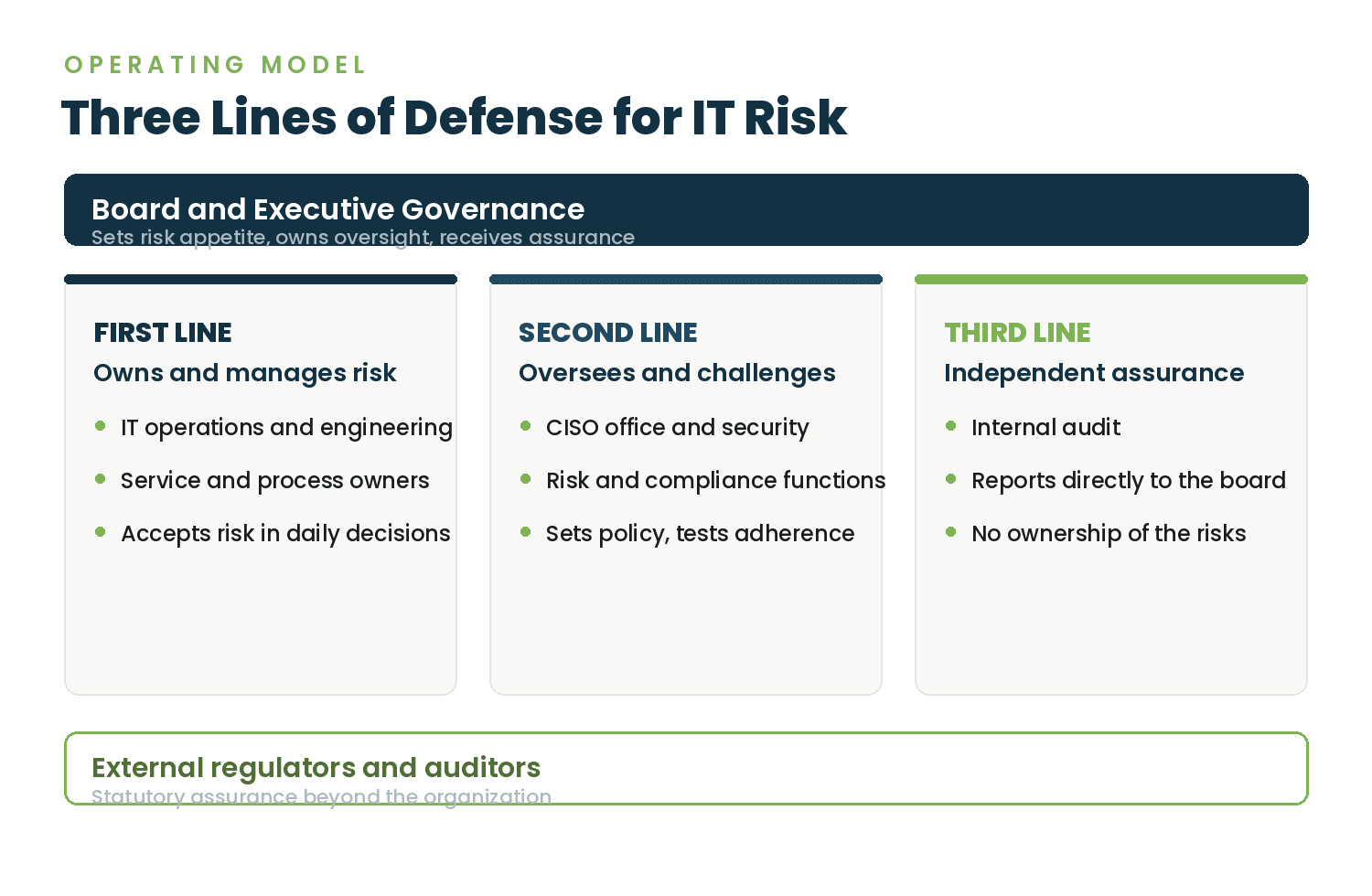
Leading organizations assign IT risk through a three-lines model, and the discipline lives in the boundaries between the lines. The first line owns and manages risk in the flow of work: IT operations, engineering, and service owners who accept risk decisions daily. The second line sets the framework and challenges the first: the CISO’s office, risk and compliance functions, and policy owners. The third line provides independent assurance to the board: internal audit, and beyond it external regulators and auditors.
The model fails in predictable ways: when the first line treats risk as someone else’s department, when the second line becomes a documentation factory instead of a challenge function, or when the third line audits controls that no longer match the technology estate. It works when the board sets explicit risk appetite and each line can articulate its role in enforcing it.
The Risk Lifecycle That Keeps Pace
Static annual risk assessments cannot govern environments that deploy weekly. The organizations that hold their risk steady share a common cadence. They identify risks continuously, from threat intelligence, incident learnings, architecture reviews, and business change. They assess each risk for likelihood and impact, increasingly in financial terms. They respond deliberately: mitigating, transferring, accepting, or terminating each risk against stated appetite. And they monitor and report so that the register reflects reality rather than last year’s architecture.
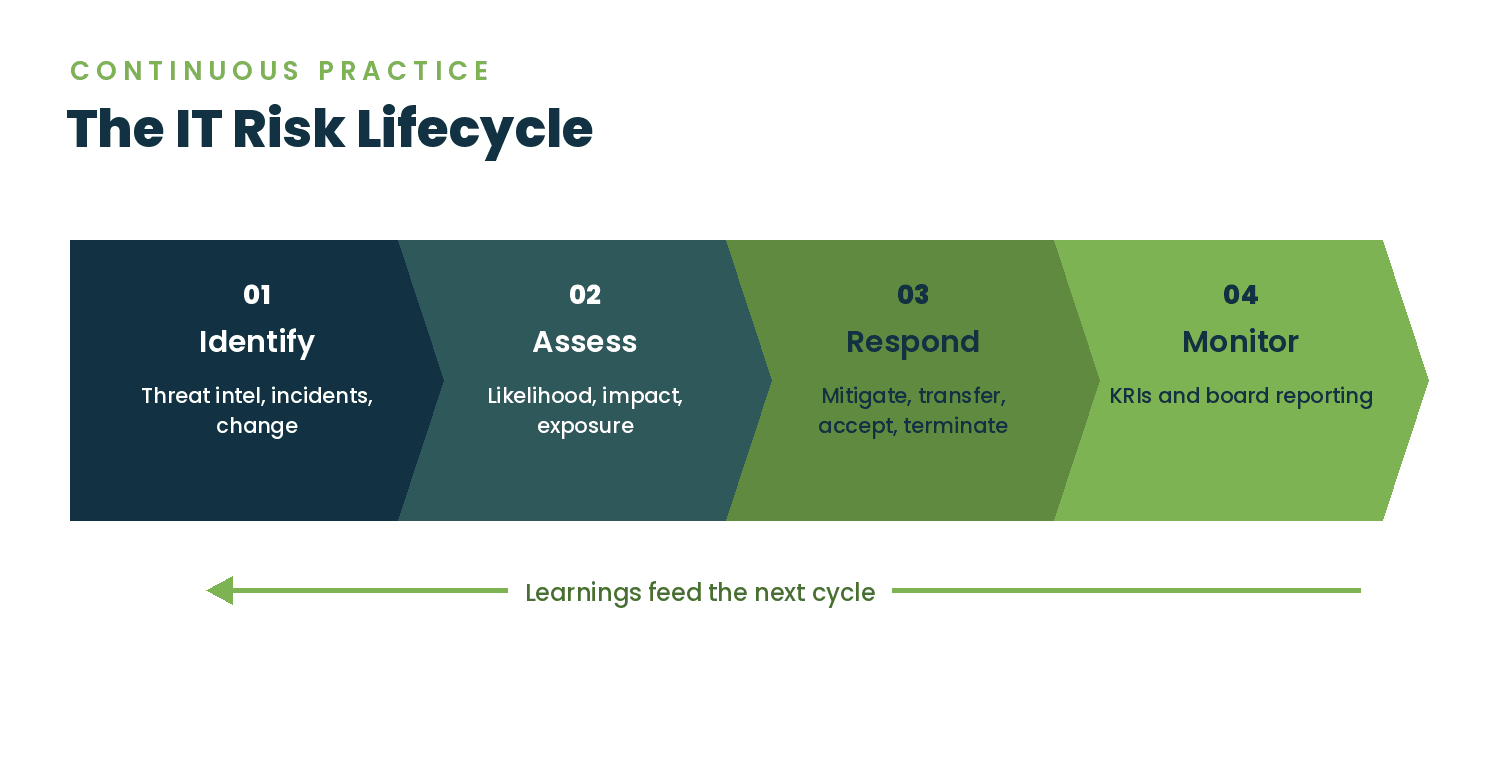
The loop matters more than any single pass through it. A risk register that is refreshed monthly from live signals, and challenged quarterly by the second line, will outperform an exhaustive annual assessment that is obsolete the week it is signed off.
From Heat Maps to Quantified Exposure
The most consequential shift in modern IT risk practice is the move from ordinal scales to quantified exposure. A heat map that says a risk is “high” invites debate about the colour. A quantified estimate that says the organization carries a 9-in-10 chance of losing less than R40 million to ransomware in a given year, in the style pioneered by factor-based risk analysis methods, invites a capital allocation decision. Quantification converts risk management from a compliance conversation into an economics conversation, which is the language boards actually govern in.
Quantification is also where preparation demonstrably pays. Organizations with extensively deployed security AI and automation saved an average of about R30 million per breach in the IBM 2025 dataset, and those with tested incident response plans reduced per-incident costs by 61%. Risk investment, measured against quantified exposure, becomes defensible in a way that checkbox compliance never was.
What Leaders Should Do Now
1. Set risk appetite in writing. A one-page statement of what the organization will and will not accept, approved by the board, converts every downstream control decision from opinion to policy.
2. Map the crown jewels. Identify the systems, data, and vendors whose failure would halt revenue or breach law, and govern those to a higher standard than the long tail.
3. Stress the third-party estate. With third-party risk now the most-cited barrier to resilience, inventory critical vendors, contract for notification and assurance rights, and monitor concentration risk before it monitors you.
4. Quantify the top five risks. Replace colour charts with estimated financial exposure and confidence ranges for the handful of risks that could actually change the organization’s trajectory.
5. Close the AI governance gap. 63% of organizations still lack policies to govern AI use, including shadow AI, and the premium for that gap is measured in hundreds of thousands of dollars per incident. AI is now both the fastest-growing attack surface and the cheapest defence, and it is governable either way.
Sources: IBM Cost of a Data Breach Report 2025; World Economic Forum Global Risks Report 2026; World Economic Forum Global Cybersecurity Outlook 2026.
Across the research, the pattern is consistent: organizations that treat IT risk as a governed discipline, with clear ownership, quantified exposure, and tested response, recover faster and lose less. That is precisely the ground on which Lebone Marang and Summer advises executives: building risk operating models that stand up to board scrutiny and real-world events alike. If the gaps in this article read like a description of your organization, start a conversation with our team.