A competitor can reverse engineer your product in a quarter, match your pricing by lunchtime, and copy your go-to-market playbook within a year. What it cannot copy is a decade of operating discipline: controls that actually run, evidence that actually exists, and a culture where doing it properly is the default. That is why the most under-rated competitive asset in modern business is a compliance programme that works.
This article makes the business case that finance and strategy leaders increasingly accept but few organizations act on: compliance, built as an operating discipline rather than an annual scramble, compounds into market advantage that rivals cannot photocopy.
At a glance
- The cost equation is settled: Ponemon research puts average non-compliance at $14.82 million (about R237 million) against $5.47 million (about R88 million) for compliance, a 2.71 times multiple.
- Non-compliance makes breaches worse: data breaches involving a non-compliance factor cost $4.61 million (about R74 million) on average, about R2.8 million more than the global norm, and 32% of breached organizations paid regulatory fines.
- Leaders already see it: 77% of C-suite executives say compliance contributes significantly to company objectives.
- Reputation dwarfs fines: for every dollar of regulatory penalty, organizations absorb roughly ten dollars of reputational loss.
The Equation Every Executive Should Know
The Ponemon Institute’s long-running cost research is the cleanest statement of the economics: organizations spend an average of $5.47 million (about R88 million) on compliance and absorb an average of $14.82 million (more than R237 million) when compliance fails, a 2.71 times multiple that includes fines, remediation, lost business, and the reputational bill that arrives after the legal one. IBM’s Cost of a Data Breach Report 2025, the industry’s benchmark breach-cost study, sharpens the point from the incident side: breaches where non-compliance was a contributing factor cost $4.61 million (about R74 million) on average, and nearly one in three breached organizations emerged from the incident facing regulatory fines.
Framed as an investment case, compliance is not a tax on doing business. It is a hedge priced at roughly a third of the loss it prevents, before counting the upside the rest of this article is about.
The Regulatory Floor Keeps Rising
South African organizations operate under a regime that has matured from guidance to enforcement. King IV set the expectation that technology and information governance be owned at board level. POPIA turned privacy from a policy document into a legal obligation with an empowered regulator, enforcement notices, criminal exposure for serious offences, and penalty ceilings of R10 million. Meanwhile the regulatory perimeter is no longer national: organizations serving European or UK customers inherit GDPR-grade obligations regardless of where their servers sit.
Two structural shifts make this permanent. First, regulators have moved from asking for policies to asking for evidence that controls operate. Second, the market itself has become a regulator: enterprise procurement teams, insurers, and investors now conduct due diligence that functions as a private-sector audit regime. The floor rises from both directions at once.
The Compliance Maturity Ladder
Organizations occupy visible rungs on a maturity ladder, and buyers can tell the difference within minutes of due diligence. At the bottom sits checkbox compliance: policies written for auditors, evidence assembled annually in a panic, and controls that exist on paper between audits. Above it, managed compliance gives the programme an owner, a calendar, and a budget. Integrated compliance builds the controls into the workflow itself, so the compliant path is also the easy path. At the top, advantage compliance turns the programme outward: certifications are marketed, assurance is offered to customers proactively, and the discipline becomes part of the brand promise.
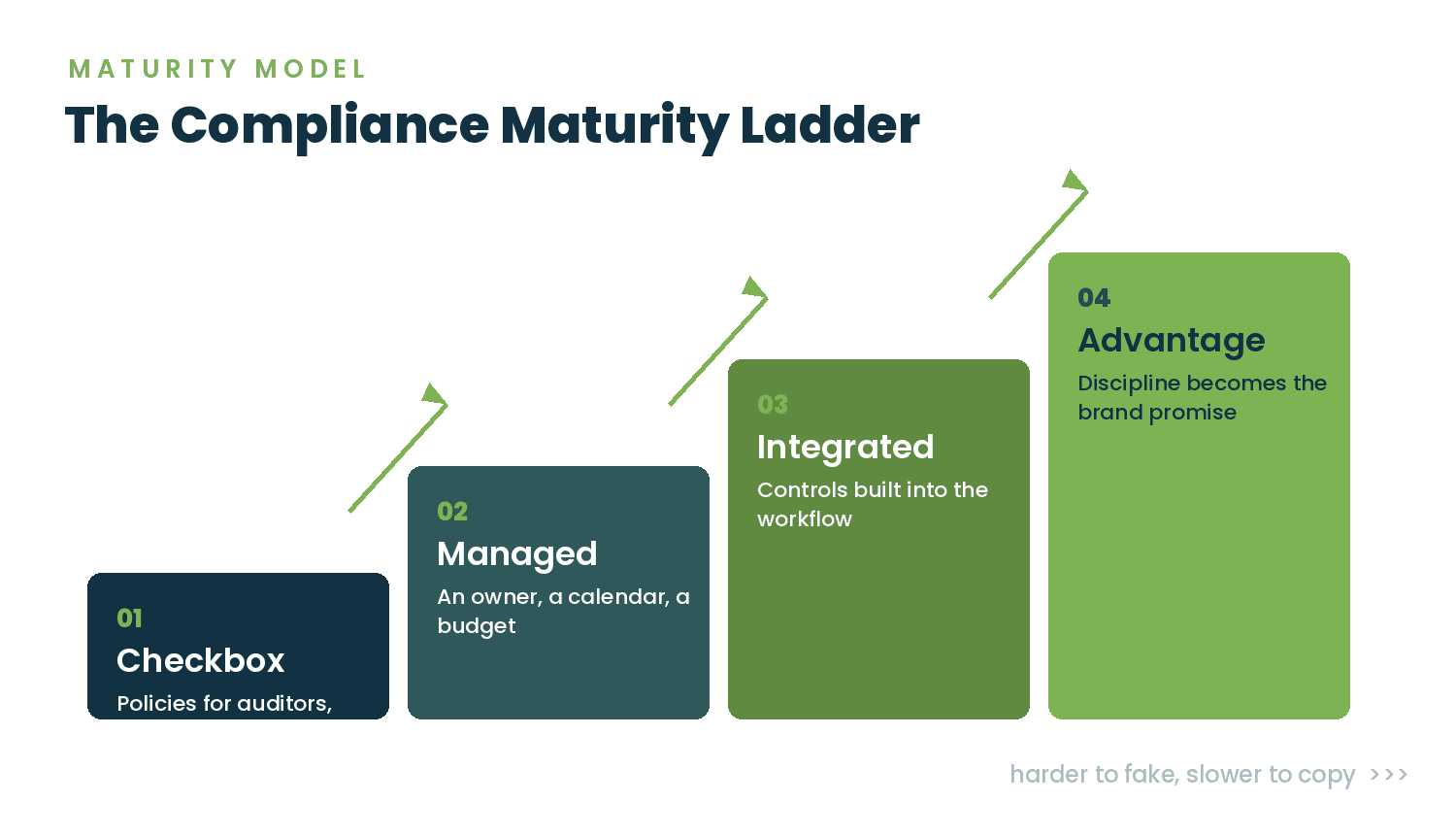
The ladder is also a map of where the advantage lives. Every rung above checkbox is progressively harder to fake and slower to copy, which is precisely what makes the top rung defensible.
Where the Advantage Actually Shows Up
Tenders and procurement. In markets where ISO 27001, PCI DSS, or sector certifications function as entry criteria, compliant organizations bid and the rest watch. The certificate does not win the deal, but its absence ends the conversation.
Sales velocity in business markets. Every serious B2B buyer now issues security and privacy questionnaires. Organizations with living evidence answer in days and keep the deal moving; organizations improvising answers answer in weeks, and momentum dies in the gap.
Insurance and financing. Cyber insurers price the quality of controls, and lenders increasingly condition terms on governance. Compliance maturity is quite literally a pricing variable.
Incident resilience. When something goes wrong, the compliant organization already has the logs, the notifications framework, and the regulator relationship. The non-compliant organization improvises its defence while under attack. The 2.71 times multiple is, in part, the price of improvisation.
The Flywheel: Why Discipline Compounds
The strategic mechanic is a flywheel. Operating discipline produces clean evidence; clean evidence earns trust from buyers, regulators, and partners; trust becomes commercial preference, winning tenders and shortening sales cycles; preference funds investment in better systems and people; and that investment deepens the discipline. Each rotation makes the next one cheaper and the advantage harder to close.
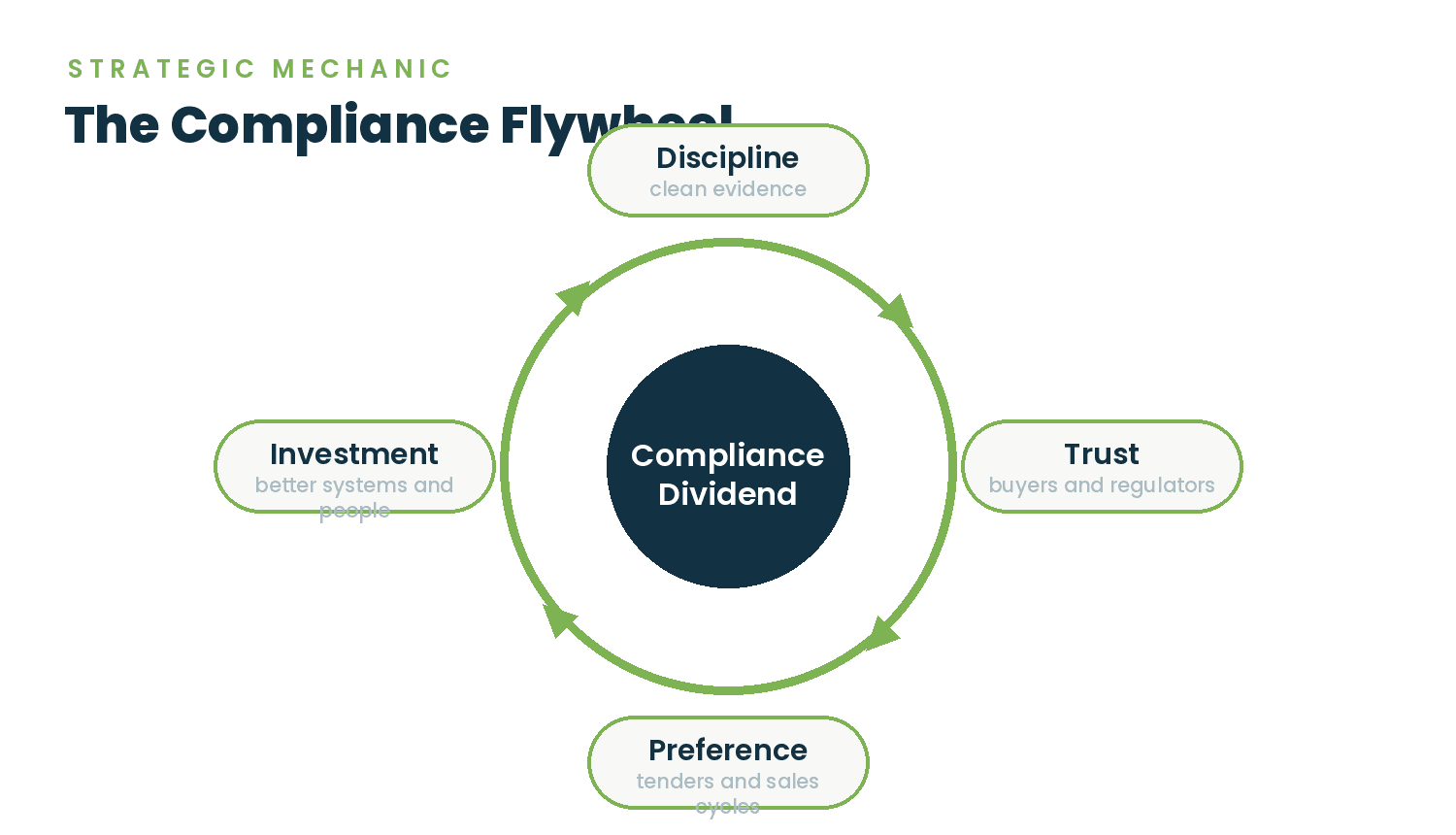
Competitors can buy the same tools and hire from the same talent pool, but culture and accumulated evidence cannot be purchased. That is the sense in which compliance is the discipline rivals cannot copy overnight: the moat is time, and time cannot be procured.
What Leaders Should Do Now
1. Reframe compliance as revenue infrastructure. Move it in the board narrative from cost centre to commercial enablement, with the 2.71 times economics on the first slide.
2. Comply once, attest many. Build a single control library mapped to multiple frameworks, so King IV, POPIA, ISO, and client questionnaires draw from one source of evidence instead of four parallel scrambles.
3. Get certified where your market pays for it. Certifications are only worth the tenders they unlock. Map your pipeline’s requirements and certify deliberately, not encyclopaedically.
4. Instrument the controls. A control whose operation cannot be shown on demand is a control that will fail its moment. Continuous evidence is the difference between managed and advantaged.
5. Sell the discipline. Brief sales teams on the assurance story: security questionnaires, client audits, and due diligence calls are not obstacles, they are the moments the compliance advantage converts.
Sources: Ponemon Institute cost of compliance research; IBM Cost of a Data Breach Report 2025; Secureframe compliance statistics 2025; King IV Report on Corporate Governance; Protection of Personal Information Act (POPIA).
The evidence points one way: compliance built as a discipline is simultaneously cheaper than its absence and more valuable than its budget line. That is the transformation Lebone Marang and Summer works with executives to achieve: governance programmes that stand up to regulators, win the confidence of buyers, and quietly out-position the competition. If your compliance programme is currently a deadline rather than a discipline, that is exactly the conversation we are good at.