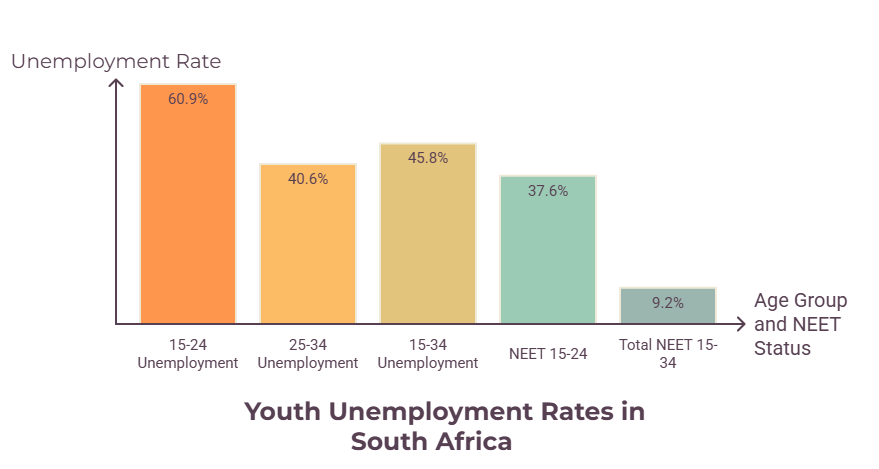
South Africa’s youth unemployment crisis is not cyclical. At 45.8% for those aged 15 to 34 as of Q1 2026, and with 9.2 million young people neither employed, in education, nor in training, the structural dimensions of the problem have consistently outpaced conventional policy responses.
A decade of intervention has produced a net deterioration: youth unemployment increased by 9.2 percentage points between 2015 and 2026, and 258,000 fewer young people were employed in Q1 2026 than in the prior period, according to .Stats SA’s Q1:2026 Quarterly Labour Force Survey.
What the data demands is a structural reorientation toward skills, entrepreneurship, and supported labour market entry.
The Scale and Composition of the Crisis
Youth unemployment in South Africa is severe across all measured cohorts, but the youngest are disproportionately affected. Among those aged 15 to 24, the unemployment rate stands at 60.9%, meaning fewer than 4 in 10 young people in this age group who are actively seeking work have found it.
The headline unemployment rate rose to 32.7% in the same period according to Stats SA, which risks obscuring the specific deterioration in youth outcomes.
Hardest-hit sectors include community and social services, construction, and retail, which historically served as entry points for low-skilled young workers.
Youth constitute 34.7% of South Africa’s total population, approximately 20.66 million people. The economic cost of sustained exclusion at this scale, across human capital, fiscal pressure, and social cohesion, is material and compounding.
Structural Causes: Why Conventional Approaches Fall Short
The persistence of youth unemployment despite sustained policy attention points to structural rather than frictional causes. Four factors are particularly significant.
Skills mismatch. South Africa’s qualification system has historically emphasised theoretical credentials over applied competence. The transition toward occupational qualifications, which embed practical workplace training, is underway but has not yet scaled to meet demand. The result is a growing gap between the skills employers require and those graduates possess.
The first-experience barrier. Entry into the labour market is disproportionately difficult for young people with no prior work history. Research indicates that securing a first structured work experience increases the probability of remaining in the labour market by 10%. Without mechanisms to create that first opportunity, many young people cycle through rejection and eventually disengage.
Non-financial barriers. Transport costs, food insecurity, poor mental health, and fragmented access to public services represent material constraints on labour market participation that financial incentives alone do not address. University of Johannesburg policy research identifies human accompaniment, rather than digital or information-based support, as the critical variable in helping young people navigate these barriers.
Suppressed entrepreneurial activity. According to historical data from the Global Entrepreneurship Monitor (GEM), South Africa’s Total Early-Stage Entrepreneurial Activity (TEA) rate for those aged 25 to 34 stood at 9.2%, less than half the African continental average. Only 8% of young South Africans engage in early entrepreneurial activity.
This is not primarily a function of appetite; the correlation between education level and entrepreneurial activity is strong. The TEA rate among those with secondary education or higher is 67.4%, compared to 4.4% among those without formal schooling, suggesting that capability development, rather than disposition, is the binding constraint.
A Framework for Meaningful Economic Participation
Addressing the crisis requires interventions that operate simultaneously across skills development, entrepreneurship enablement, and work readiness. Programmes that target only one dimension consistently underperform, because the barriers young people face are interdependent.
Lebone Marang and Summer, a South African-based organisation operating at this intersection, applies a three-pillar model designed to address the compounding nature of youth exclusion:
| Pillar | Intervention | Lebone Marang and Summer Delivery |
| Digital Skills | IT training, coding, web development, digital tools | Core training programme |
| Entrepreneurship | Venture connections, startup support, business development | Entrepreneurial capability training |
| Work Readiness | Mentorship, soft skills, internship access | One-on-one mentorship and real-world experience |
Two design features distinguish this model from conventional programme delivery. First, participation is fully funded by partners, removing the financial barrier entirely. Second, the framework specifically targets qualified IT graduates who possess foundational knowledge but lack the commercial experience, soft skills, or corporate networks required to secure high-value employment.
The broader market signal supports this approach. Data monitored by industry analysts in mid-2025 highlighted a 3.5% surge in youth entrepreneurship activity, with a measurable increase in youth-led ventures converting early-stage ideas into operating businesses.
Recommendations by Stakeholder
Government. The transition to occupational qualifications should be accelerated, with workplace placement embedded as a core requirement rather than an elective component. Investment in in-person support infrastructure, distinct from digital platform provision, is necessary to address the non-financial barriers that currently suppress labour market participation. Dedicated funding mechanisms for youth business startup support require expansion in both scale and accessibility.
Private sector. Structured first-work-experience programmes represent a high-return, low-complexity intervention. Partnering with established delivery organisations such as Lebone Marang and Summer provides a direct pipeline to work-ready talent while reducing recruitment and onboarding costs. Targeted investment in youth entrepreneurship funding addresses both social impact objectives and longer-term supplier and market development goals.
Education and training providers. Alignment with occupational qualification frameworks and closer integration with employer requirements will improve graduate outcomes. Institutions with strong industry networks should formalise pathways between academic programmes and structured workplace experience.
As an organization, Lebone Marang and Summer directly operationalizes this multi-stakeholder model through its localized delivery strategy. By auditing specific digital skill shortages within regional business hubs, the organisation tailors its curriculum to ensure that graduates possess immediately deployable capabilities.
This targeted approach bridges the divide between corporate procurement needs and unemployed IT graduates, demonstrating how civil society can turn theoretical economic frameworks into measurable placement outcomes.
For readers looking for practical pathways, our For Youth page explains the available skills and opportunity routes, while the For Partners page outlines how organisations can support youth development and employment.
The Strategic Imperative
Youth Month 2026, anchored in the national sub-theme “Mapping the Barriers: Auditing Access for Economic Inclusion,” coincides with a moment of measurable urgency. The 50th anniversary of the Soweto Uprising is a meaningful marker, but the more pressing question is whether South Africa’s policy and private sector institutions can match the scale of the structural challenge with an equivalent scale of structural response.
The data is unambiguous: incremental interventions applied to a structural problem produce incremental outcomes. A coordinated shift toward occupational skills development, supported labour market entry, and entrepreneurship enablement, delivered through organisations with the operational capacity and programme design to reach the 9.2 million young South Africans currently outside employment, education, and training, is both necessary and achievable.
To learn more, explore our youth opportunities or partnership opportunities.