
A National Crisis Hiding in Plain Sight
South Africa is facing one of the most significant education challenges in the developing world. More than three-quarters of South African children cannot read for meaning by the time they reach Grade 3 or Grade 4. In a modern economy where knowledge, digital skills, and problem-solving are essential, this has consequences that extend well beyond the classroom.
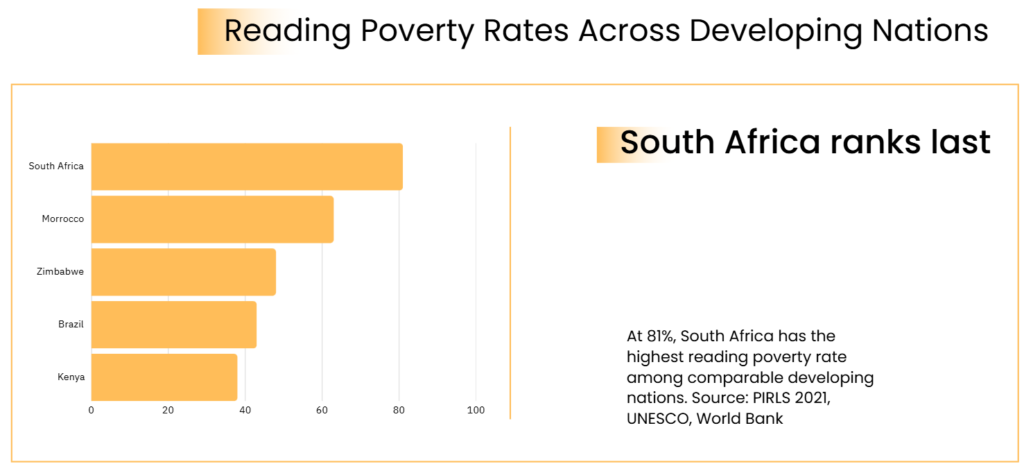
This is not only an education problem. It is an economic, social, and development challenge that threatens the country’s long-term competitiveness. The World Bank defines learning poverty as the inability to read and understand a simple text by age 10, a threshold that the majority of South African children are currently not meeting.
The early years of schooling form the foundation on which all future learning is built. When learners fall behind in reading during these years, the gap widens steadily as they progress through school. By the time they reach secondary school or enter the labour market, many lack the foundational skills needed to participate fully in the economy.
For policymakers, educators, and organisations working in youth development, the Grade 3 reading crisis signals an urgent need for systemic reform and targeted intervention.
The Scale of the Problem
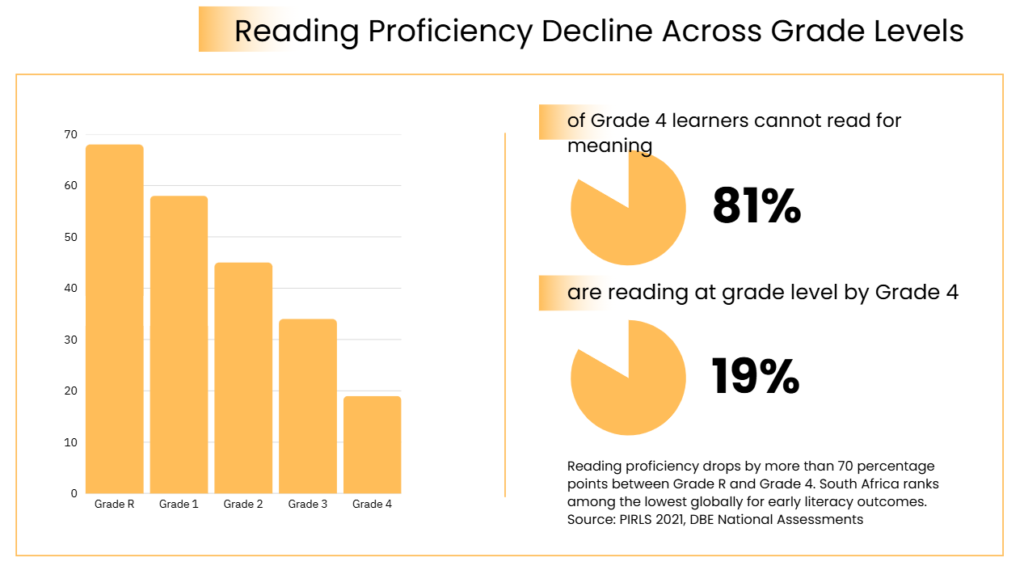
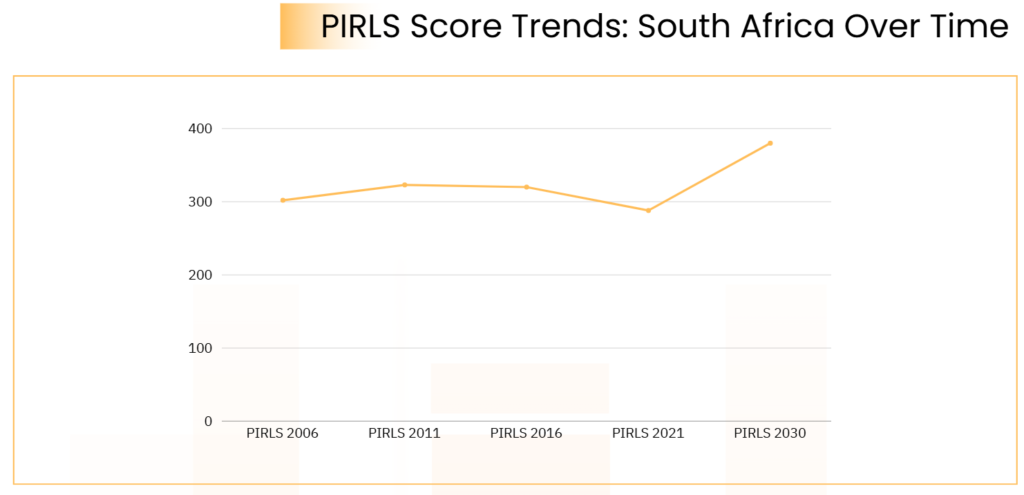
South Africa’s early literacy outcomes consistently rank among the lowest globally. The Progress in International Reading Literacy Study has repeatedly highlighted the severity of the issue. According to the most recent results, approximately 81 percent of Grade 4 learners in South Africa cannot read for meaning in any language.
This represents millions of children entering upper primary school without the ability to understand basic written text. UNICEF identifies early literacy as a critical development priority across sub-Saharan Africa, underscoring that South Africa’s crisis is part of a broader regional challenge.
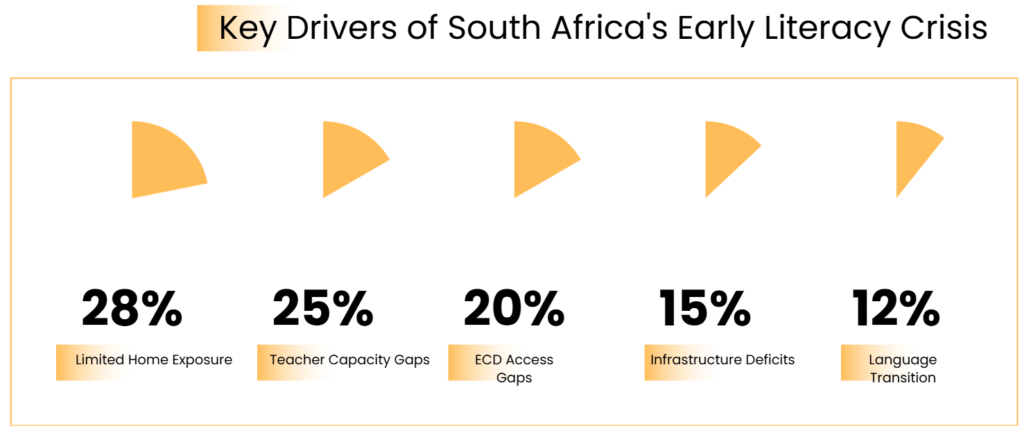
Several structural factors drive this outcome. Many learners begin school without prior exposure to books, storytelling, or early literacy stimulation at home. In disadvantaged communities, access to early childhood development programmes and reading materials is often severely limited.
In many schools, educators also lack specialised training in teaching reading, phonics, and language development, particularly in multilingual environments. Numerous schools operate without functioning libraries, sufficient reading materials, or adequate classroom resources.
Many learners are also taught in their home language in the early grades, but transition to English as the language of instruction later in primary school, often before reading proficiency has been fully established.
Together, these factors create a system where millions of children cannot acquire basic literacy during the most critical stage of their cognitive development.
Why Early Reading Proficiency Matters
Early reading proficiency is one of the strongest predictors of long-term academic success. Children who can read fluently by the end of Grade 3 are significantly more likely to perform well in mathematics, science, and other subjects in later grades. Reading is the gateway skill that enables learners to access all other forms of knowledge.
Learners who cannot read at this stage often fall progressively further behind. They struggle to understand textbooks, complete assignments, and engage meaningfully with classroom instruction. International research consistently shows that children who are not proficient readers by age ten are more likely to drop out of school before completing secondary education.
The implications extend beyond academic performance. Literacy is closely linked to employability, productivity, and income potential in adulthood. In an economy increasingly shaped by technology and digital platforms, reading ability forms the basis for acquiring more advanced skills such as coding, data analysis, and critical thinking.
For a country seeking to compete in the global knowledge economy, foundational literacy is not optional. It is a strategic national asset.
The Economic Consequences of the Literacy Gap
The Grade 3 reading crisis carries significant economic consequences for South Africa.
Employers across sectors consistently report a shortage of workers with strong foundational skills. When learners progress through the education system without mastering reading, the entire skills pipeline is compromised. Young people who leave school without adequate literacy and numeracy skills face limited employment opportunities and often cannot meet the basic requirements of formal sector jobs.
The literacy gap also deepens inequality. Learners from wealthier households typically have access to books, tutoring, and better-resourced schools. Learners from disadvantaged communities fall further behind, reinforcing existing socioeconomic disparities.
At a national level, low literacy constrains overall economic growth. Countries with stronger education systems consistently experience higher rates of innovation, better labour market outcomes, and greater long-term prosperity.
Addressing early literacy is therefore not only a moral imperative. It is an economic priority.
What Successful Interventions Look Like
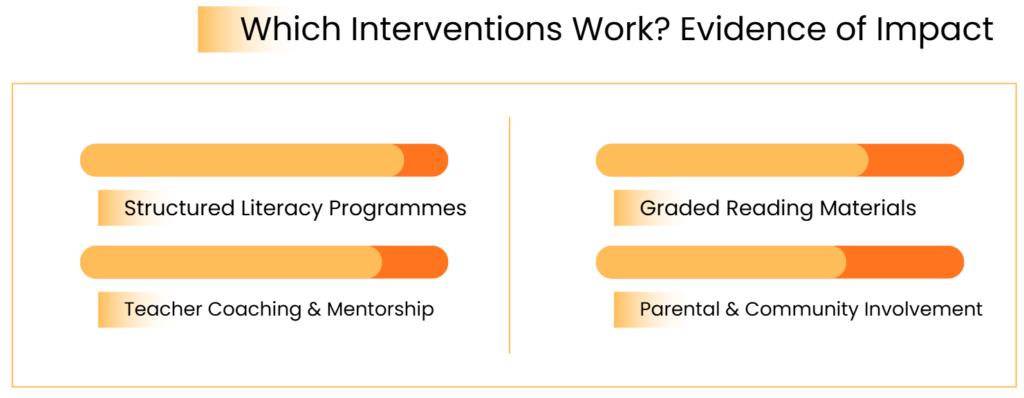
Despite the scale of the challenge, evidence from both local and international programmes shows that early literacy outcomes can improve significantly with targeted interventions. Effective strategies share common characteristics.
Structured literacy programmes that provide teachers with clear lesson plans, phonics instruction methods, and regular assessment tools have delivered strong results across multiple contexts. Simply increasing the number of graded reading books available to learners has also been shown to improve outcomes, as it allows children to practise reading at the appropriate level of difficulty.
Teacher coaching and mentorship programmes improve outcomes by helping educators refine their instructional techniques over time. Ongoing professional support is consistently more effective than once-off training. Community and parental involvement also play a critical role. Encouraging reading at home through storytelling and shared reading activities reinforces classroom learning and makes a measurable difference to early literacy development.
Technology is increasingly playing a supportive role as well. Digital reading platforms, mobile learning applications, and audiobooks can expand access to literacy resources in under-resourced areas where physical book distribution remains difficult.
The most effective programmes combine several of these approaches rather than relying on a single intervention. The Zenex Foundation has documented strong results from structured literacy programmes in South African schools, particularly where teacher coaching and graded reading materials are combined.
The Role of Civil Society and Innovation
While government remains the primary provider of basic education, civil society organisations, NGOs, and innovation-driven initiatives play an important role in addressing systemic gaps.
Youth development organisations often operate closer to communities. They can experiment with innovative programme models and respond more quickly to local needs than large public systems. Mentorship programmes, after-school literacy initiatives, and digital learning platforms can meaningfully supplement formal education.
Innovation hubs focused on youth empowerment are increasingly integrating foundational literacy support into broader skills development programmes. By combining digital training, mentorship, and early learning support, these initiatives help bridge the gap between education and employability.
In this context, early literacy becomes the starting point of a much larger skills development pipeline, one that connects classroom learning directly to economic participation.
Building a National Literacy Movement
Solving the Grade 3 reading crisis will require coordinated action across multiple sectors.
Education policy must prioritise early-grade reading as a national development objective. The Department of Basic Education’s Early Grade Reading Assessment tracks progress against national literacy targets, providing a framework for measuring improvement over time. This means strengthening teacher training, improving curriculum design, and ensuring that schools have access to appropriate learning materials. Investment in early childhood development must also increase, particularly in underserved communities where learning gaps begin before formal schooling even starts.
Public-private partnerships can play a meaningful role by supporting literacy initiatives, funding school libraries, and developing digital learning solutions at scale. Media campaigns and community engagement can help build a culture of reading, one where books are valued and reading at home is normalised from an early age.
Ultimately, solving this crisis requires a long-term commitment across government, business, civil society, and communities. There are no quick fixes. But the evidence is clear that with the right investments and sustained effort, early literacy outcomes can and do improve.
Conclusion: Fixing the Foundation
The Grade 3 reading crisis is one of the most critical challenges facing South Africa’s education system. When children cannot read during the early years of schooling, the consequences cascade throughout their academic journey and into adulthood.
The stakes extend beyond individual outcomes. They reach into the country’s workforce, its innovation capacity, and its long-term economic trajectory. If South Africa can close the early reading gap, it will unlock opportunities for millions of young people and lay the foundation for a more inclusive, more competitive, and more resilient economy.
The work starts in Grade 3. The impact lasts a lifetime.